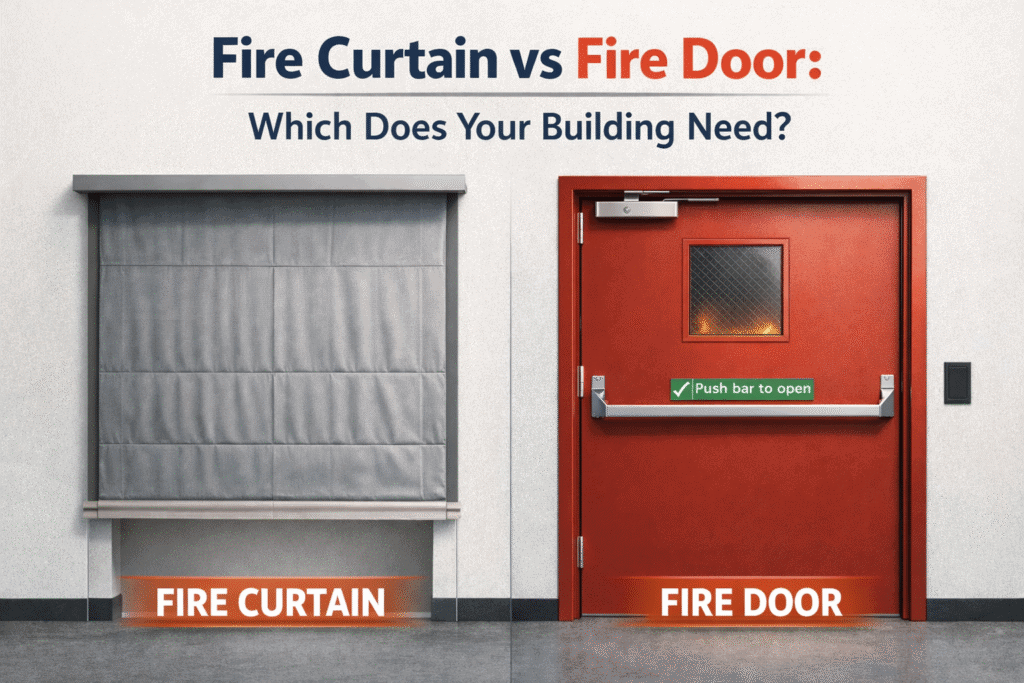
A fire curtain is an automatic fabric barrier that deploys from the ceiling to seal openings during a fire — ideal for atriums, lobbies, and open-plan spaces where rigid barriers aren’t possible. A fire door is a fixed rated door assembly for high-traffic openings requiring constant access. Both are compliant with NBC 2016, but they solve different architectural problems.
When architects, facility managers, and contractors specify fire safety solutions for Indian buildings, the question of fire curtain versus fire door comes up on virtually every project. Both systems meet fire compartmentation requirements under the National Building Code of India 2016 and EN 1634-1 — but they are not interchangeable. Choosing the wrong system costs money, compromises safety, and can fail building compliance inspections.
This guide covers the technical differences, the applications where each system excels, and how to make the right specification decision for your project.
What is a Fire Curtain?
A fire curtain is a passive fire protection system consisting of a fire-resistant fabric curtain rolled inside a concealed head box, mounted at ceiling level. When a fire alarm triggers — or when power fails — the curtain deploys automatically under gravity, descending to floor level and sealing the opening against fire, smoke, and radiant heat.
Window Techs manufactures fire curtains under the EN 1634-1 standard, tested and certified by TÜV and Efectis laboratories. Our curtains use 0.6mm thick polyurethane-coated woven glass fibre fabric reinforced with stainless steel wire, providing up to 240 minutes of fire integrity. The gravity fail-safe mechanism ensures deployment even during complete power failure — a mandatory requirement for life safety systems.
The fabric is manufactured on the world’s longest automatic sewing machine — imported from Italy, capable of stitching up to 25 metres in length with dual-needle precision and stainless steel thread. This is not a generic product. Every curtain is engineered to the opening it protects.
What is a Fire Door?
A fire door is a certified door assembly — including the door leaf, frame, seals, hinges, and closing mechanism — rated to resist fire for a specified period. Fire doors are static barriers: they remain in place permanently and must be kept closed (or held open by magnetic hold-open devices linked to the fire alarm system).
Window Techs manufactures 12 types of fire-rated and specialist doors under EN 1634-1 and IS 16947, including single-leaf fire doors, double-leaf fire doors, fully glazed fire doors, and cleanroom doors. Our doors are precision-manufactured on imported Italian multi-axis punching machines with 0.05mm accuracy and bending machines with ±0.05° precision.
Key Differences — Fire Curtain vs Fire Door
| Feature | Fire Curtain | Fire Door |
|---|---|---|
| Visibility when not active | Completely concealed in ceiling | Permanently visible |
| Opening width | Unlimited (up to 100m+ in a single run) | Limited by door leaf size (typically up to 2.4m) |
| Opening height | Up to 25m drop (unlimited with WFC-03) | Standard door heights only |
| Architectural impact | Zero — invisible when retracted | Permanent visual presence |
| Fire integrity (max) | 240 minutes (EN 1634-1) | 240 minutes (EN 1634-1) |
| Deployment | Automatic via fire alarm / gravity fail-safe | Self-closing or hold-open device |
| Through-traffic when active | Possible with egress curtain (WEFC-01) | Yes — push to open |
| Large span openings | Ideal — no structural limitations | Not suitable beyond ~2.4m width |
| Maintenance | Annual service recommended | Minimal — door seal checks |
| NBC 2016 compliance | Yes | Yes |
| Cost for large openings | Significantly lower | High — multiple door sets required |
When to Choose a Fire Curtain
Fire curtains are the correct specification when the architectural brief requires open, unobstructed spaces in normal use, with fire compartmentation only when needed. The key use cases are:
Atriums and Open-Plan Floors
Modern commercial buildings, hotels, and shopping malls are designed around open atriums. Placing fire doors across these spaces is architecturally impossible — and structurally impractical. Fire curtains deploy from concealed ceiling housing to seal the atrium in an emergency, then retract completely when reset. This is why Window Techs fire curtains are specified for premium commercial properties across India.
Lift Lobbies and Lift Doors
NBC 2016 requires fire compartmentation around lift lobbies in multi-storey buildings. Fire curtains create a protected lobby in front of elevator banks — replacing the need for physical fire-rated partitions while maintaining an open, aesthetically neutral environment. Intelligent control systems can be linked to elevator operation to maintain escape routes.
Escalators and Internal Stairs
Smoke curtains around escalator openings create a deep smoke reservoir at ceiling level, preventing smoke migration between floors. Fire curtains can seal stairwells completely when required. This is a mandatory consideration for shopping malls and multi-storey retail under NBC 2016 Part 4.
Large Convention and Exhibition Spaces
Window Techs installed what is believed to be the largest fire curtain ever commissioned in India at Bharat Mandapam — the International Exhibition-cum-Convention Centre at Pragati Maidan, New Delhi, which hosted the G20 Summit. The installation spans 100 metres in width and 20 metres in height. No fire door system could achieve this. The same scale installation was delivered at IICC Dwarka (Yashobhoomi).
Airports and Transport Hubs
Window Techs has installed nearly 60 fire curtains at Rajiv Gandhi International Airport, Hyderabad. Airport terminal design demands open sightlines and unobstructed passenger flow — fire curtains deliver compartmentation without compromising the terminal environment.
Restaurants and Commercial Kitchens
Fire and smoke curtains are required wherever kitchen operations are adjacent to dining areas. The curtain automatically deploys in a fire or smoke event, isolating the kitchen from the dining space and preventing spread.
When to Choose a Fire Door
Fire doors are the correct specification when the opening requires constant, regular through-traffic and the door needs to be a functional part of the building in both normal and emergency conditions.
- Stairwell access doors — required for daily use, must self-close after passage
- Plant room and service area access — high security and fire containment combined
- Corridor compartmentation in hospitals, hotels, and residential buildings — standard door openings with fire rating requirements
- Server room and data centre access points — where controlled access and fire rating are both required
- Cleanroom entry vestibules — where environmental control and fire safety overlap (Window Techs cleanroom doors meet both requirements)
Can Fire Curtains Replace Fire Doors?
Yes — and this is increasingly common in Indian commercial construction. NBC 2016 Part 4 mandates fire compartmentation but does not prescribe the specific system to achieve it. Fire curtains certified under EN 1634-1 satisfy the compartmentation requirement wherever a fire door would be specified, provided the curtain achieves the same or greater fire integrity rating.
The practical advantage is significant: a fire curtain spanning a 6-metre opening costs considerably less than multiple fire door sets across the same opening, requires no structural framing, and adds zero visual disruption to the space. Window Techs fire curtains have replaced traditional fire door solutions at Google, Amazon, and Walmart facilities across India — environments where both performance and aesthetic standards are uncompromising.
Window Techs Fire Curtain Specifications at a Glance
| Model | Max Width | Max Drop | Integrity | Standard |
|---|---|---|---|---|
| WFC-01 | 6M | 25M | 240 min | EN 1634-1 |
| WFC-02 | Unlimited | 25M | 240 min | EN 1634-1 |
| WFC-03 | Unlimited | Unlimited | 240 min | EN 1634-1 |
Notable Fire Curtain Projects by Window Techs
Window Techs installed the largest fire curtain in India at the International Exhibition-cum-Convention Centre at Pragati Maidan — 100 metres wide and 20 metres high. This government infrastructure project required the highest performance fire protection at monumental scale.
A second 100-metre wide, 20-metre high installation at India’s premier convention destination. Window Techs delivered the same record-scale curtain system at this landmark venue.
Close to 60 fire curtains installed across the terminal, contributing to the fire safety of one of India’s busiest international airports and its millions of annual passengers.
Window Techs’ fire curtain installations at Walmart’s South India facilities led to an expanding partnership across multiple store locations, meeting the retailer’s global fire safety standards.
Advanced fire curtain installations protecting Google’s South India facilities — among the most demanding performance environments for fire safety specification in India.
Making the Right Decision for Your Project
The specification decision between fire curtain and fire door is straightforward when you map it to the architectural and functional requirements of each opening:
- Large span opening, open aesthetic required, compartmentation only in emergency → Fire Curtain
- Standard door-sized opening, daily through-traffic, always-present barrier → Fire Door
- Atrium, lobby, escalator opening, convention space → Fire Curtain
- Stairwell, plant room, corridor door, cleanroom vestibule → Fire Door
- Both required on the same floor → Window Techs manufactures and supplies both systems
Window Techs’ engineering team reviews project drawings and provides system recommendations, fire rating calculations, and full specification documentation for NBC 2016 compliance submissions. Contact us to discuss your project requirements.
Specify the Right System for Your Project
Window Techs’ team will review your drawings and recommend the correct fire curtain or door specification — with full compliance documentation for NBC 2016.
Talk to Our TeamFrequently Asked Questions
Can a fire curtain replace a fire door in India?
Yes. NBC 2016 Part 4 mandates fire compartmentation but does not specify the system. EN 1634-1 certified fire curtains satisfy the same compartmentation requirement as fire doors, provided they achieve the required integrity rating. Window Techs fire curtains have replaced fire door solutions at Google, Amazon, and Walmart facilities across India.
What is the maximum width a fire curtain can span?
Window Techs WFC-02 and WFC-03 models have unlimited width capability. The largest single installation by Window Techs spans 100 metres in width at Bharat Mandapam, New Delhi — the venue that hosted India’s G20 Summit. WFC-01 handles openings up to 6 metres wide.
Are fire curtains approved under NBC 2016?
Yes. Window Techs fire curtains are fully compliant with the National Building Code of India 2016, Part 4 — Fire and Life Safety. They are also certified under EN 1634-1 and tested by TÜV and Efectis — internationally recognised fire testing laboratories.
What happens to a fire curtain during a power failure?
Window Techs fire curtains use a gravity fail-safe mechanism. When power fails or the fire alarm triggers, the motorised brake releases and the curtain descends under gravity at a controlled speed — requiring no power, no manual operation, and no external intervention. This is a mandatory feature under EN 1634-1.
How long do fire curtains take to manufacture and install?
The standard manufacturing timeline is 3 to 4 weeks from order confirmation and deposit receipt, subject to specification review. Window Techs provides pan-India installation and commissioning, with engineers experienced across airport, hotel, hospital, data centre, and government project environments.
Which is better for a shopping mall — fire curtain or fire door?
Fire curtains are strongly preferred for shopping malls. Mall design requires open sightlines, wide corridor openings, and large atrium spaces — all of which fire doors cannot accommodate. Smoke curtains around escalators and fire curtains across atrium openings provide compliant compartmentation without any visual impact on the retail environment.